
 Back to resources
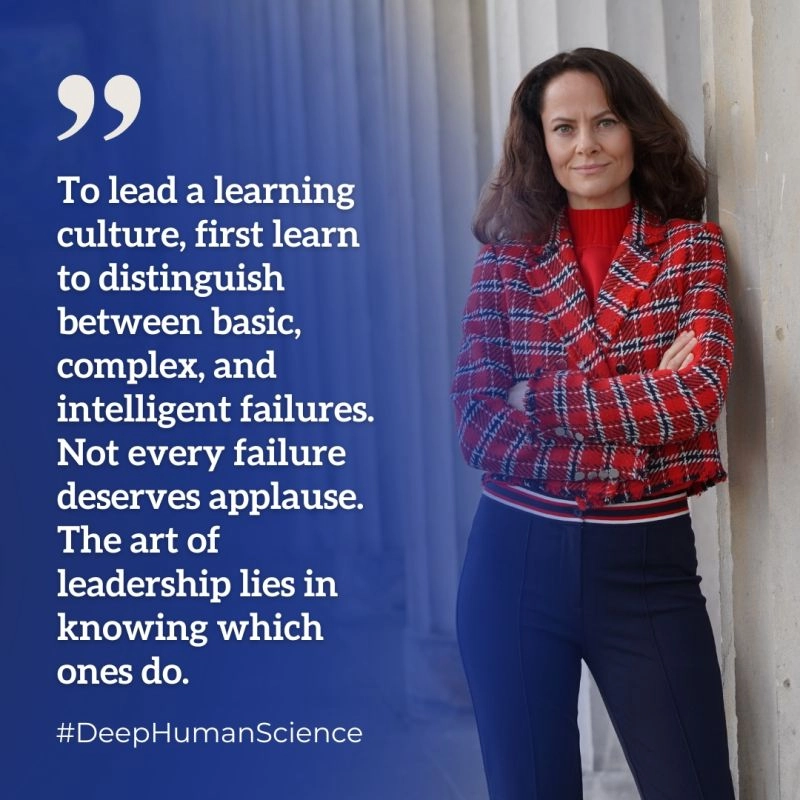
To build a real learning culture, you need to distinguish different kinds of failures

Not all failures are created equal.
One of the biggest reasons leaders struggle to create a learning culture is the lack of clarity around what failure actually means.
In law firms especially, leaders often hesitate to promote learning from failure because they fear it might lower standards or encourage carelessness.
They ask themselves:
→ How can I address failures constructively while keeping performance standards high?
→ How can I avoid normalizing mistakes that could easily have been prevented?
The truth is: You don’t have to celebrate every failure — and you shouldn’t.
According to Prof. Amy C. Edmondson from Harvard Business School, there are three distinct types of failure — and understanding the difference is crucial for any legal team navigating transformation.
1. Basic Failures
They have a single, predictable cause.
They happen in contexts where you already had the necessary information — but didn’t use it.
Examples: forgetting to proofread a document, failing to verify a client’s name, or texting while driving.
Basic failures shouldn’t be celebrated. But they do offer a chance to pause, reflect, and put measures in place to prevent them from happening again.
2. Complex Failures
They have multiple, interacting causes.
They happen in variable contexts where several factors overlap — often in everyday routines.
Example: You wake up late for an important client meeting, feel unwell, can’t find parking, your assistant forgets key documents, and you enter the meeting distracted.
As a result, you miss the opportunity to connect meaningfully with your new client.
Because complex failures are multi-causal, you often have several chances to notice and correct the course.
One moment of awareness can be enough to change the outcome.
3. Intelligent Failures
They occur in new territory — where no proven solution exists and experimentation is necessary.
You’ve gathered as much data as possible, acted on reasonable assumptions, and still, the outcome didn’t go as planned.
Example: You introduce a new legal-tech tool or pricing model based on solid research and client feedback. Yet adoption is slow, or clients don’t engage as expected.
These are the failures to embrace.
Intelligent failures drive innovation, generate insight, and help refine the next iteration.
By accepting them as part of growth, you turn uncertainty into a powerful learning engine.
Want to go deeper?
If this resonates with you, explore Amy C. Edmondson’s brilliant book:
Right Kind of Wrong – The Science of Failing Well,
winner of the 2023 Financial Times and Schroders Business Book of the Year Award.
Inspired by the work of Prof. Amy C. Edmondson, Novartis Professor of Leadership and Management at Harvard Business School – ranked #1 on the Thinkers50 list of global management thinkers.
Read the full article